



Just start typing...
News

ML-based module to detect users’ fraudulent activity

Published March 6, 2018
Let us tell you more about our projects
Start here

WaveAccess developed an anti-fraud system to protect telecom companies from fraud attacks. The solution is based on Machine Learning and fuzzy logic algorithms. The security module recognizes suspicious actions as threats.
Telecommunication companies are constantly exposed to fraud attacks. There are attempts to gain access by using fake IP addresses, stolen credit card numbers, password matching and other attacks — it is impossible to guess what the fraudsters will come up with. The suspicious actions are easily confused with the actions of a simple user, e.g., with an input error or access from a new device. Therefore, the standard software protection tools become less effective and just downloading antivirus software doesn’t work — special tools are required to study user behavior and compare it with potential threats.

WaveAccess developed a machine learning based module that helps safely protect telecom companies — the system detects attacks in time, even if more than a million accounts are logging in. WaveAccess experts analyzed the most common threats, defining and formalizing 16 main threats types. For each of them an algorithm was developed that determines how a threat will be defined and dealt with. For some threats, a user’s feedback is requested, which determines the reaction to a threat.
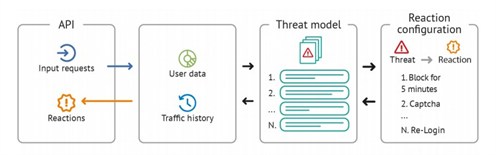
WaveAccess_anti-fraud system_the model of reactions to threats

The model of reactions to threats

To keep setup and monitoring processes simple, WaveAccess developed the submodule with UI. It monitors event logs and security logs and sets up the Anomaly Monitor’s subsystems.
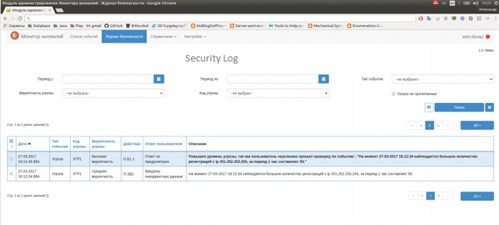
WaveAccess_anti-fraud system_security log

WaveAccess implemented a number of load tests and integration tests to ensure that the protection module can easily handle a huge amount of input data. For Integration testing, the testing utility — scripts imitator — was developed. It simulates the load on the subsystem and helps to implement integral testing of the main module using templates. This approach saved time and resources that are normally spent on manual testing. It also allowed to add the testing into Continuous Integration.


Let us tell you more about our projects

 Start here

WaveAccess creates similar machine learning based modules for “smart” recommendations in online stores; the same algorithms are used by the company's clients to calculate the probability of an insured event; to predict the probability of buying and other business tasks. These solutions can also be applied for protection by examining and detecting abnormal user behavior.

Find out more about the project in our case.

Download the case

Energy Management System for Mata Energy

The solution is aimed to facilitate sector-coupled energy supply, improving its efficiency. For the client we provided a consulting session, and developed an MVP.

Why multi-agent systems fail: three causes and how to fix them

Multi-agent systems often show managerial problems: agents fail to share information, follow roles mechanically, or drift into unproductive chatting. Today let’s see why good engineering is more important than improvement of prompts.

MCP-powered platform uniting AI Agents into a single ecosystem

By shifting from isolated AI pilots to a centralized enterprise framework, businesses can finally automate complex workflows and accelerate decision-making without compromising on governance or LLM independence. Here’s how we solve these scaling challenges with our enterprise-ready solution.
When every department builds its own AI agent with its own data, logic, and tools, organizations can find themselves with a "zoo" of disconnected systems. Instead of scaling, these silos cause the company to slow down. Paul Chayka, Integration and AI Solutions Expert, breaks down how to innovate responsibly by selecting the right initial use cases, and shifting from simple task automation to a coordinated multi-agent ecosystem.
For a Forbes Global 2000 client, we automated the process of matching adverse event descriptions from clinical reports with standardized MedDRA vocabulary — achieving over 95% automation, including terms that specialists previously failed to map manually. Faster and more accurate processing of clinical data reduces R&D costs, accelerates regulatory submissions, and ultimately supports faster delivery of new treatments.
At WaveAccess’s first AI Jam, a collaborative, role-play session built on authentic AI use cases, business leaders exchanged perspectives on what works with AI today and what still needs clarity. The conversation surfaced both practical opportunities and shared concerns around accountability and leadership.

Related Services

How we process your personal data

When you submit the completed form, your personal data will be processed by WaveAccess USA. Due to our international presence, your data may be transferred and processed outside the country where you reside or are located. You have the right to withdraw your consent at any time.
Please read our Privacy Policy for more information.