



News

ML-based module to detect users’ fraudulent activity

author
Marketing Team
WaveAccess
Published March 6, 2018
Let us tell you more about our projects
Start here

WaveAccess developed an anti-fraud system to protect telecom companies from fraud attacks. The solution is based on Machine Learning and fuzzy logic algorithms. The security module recognizes suspicious actions as threats.

Telecommunication companies are constantly exposed to fraud attacks. There are attempts to gain access by using fake IP addresses, stolen credit card numbers, password matching and other attacks — it is impossible to guess what the fraudsters will come up with. The suspicious actions are easily confused with the actions of a simple user, e.g., with an input error or access from a new device. Therefore, the standard software protection tools become less effective and just downloading antivirus software doesn’t work — special tools are required to study user behavior and compare it with potential threats.

WaveAccess developed a machine learning based module that helps safely protect telecom companies — the system detects attacks in time, even if more than a million accounts are logging in. WaveAccess experts analyzed the most common threats, defining and formalizing 16 main threats types. For each of them an algorithm was developed that determines how a threat will be defined and dealt with. For some threats, a user’s feedback is requested, which determines the reaction to a threat.
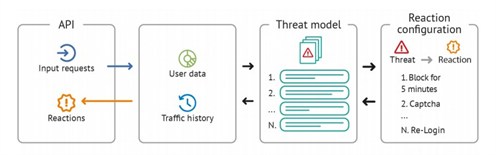
WaveAccess_anti-fraud system_the model of reactions to threats

The model of reactions to threats

To keep setup and monitoring processes simple, WaveAccess developed the submodule with UI. It monitors event logs and security logs and sets up the Anomaly Monitor’s subsystems.
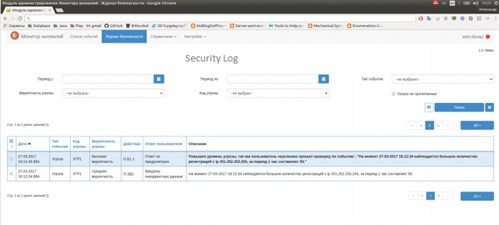
WaveAccess_anti-fraud system_security log

WaveAccess implemented a number of load tests and integration tests to ensure that the protection module can easily handle a huge amount of input data. For Integration testing, the testing utility — scripts imitator — was developed. It simulates the load on the subsystem and helps to implement integral testing of the main module using templates. This approach saved time and resources that are normally spent on manual testing. It also allowed to add the testing into Continuous Integration.


Let us tell you more about our projects

 Start here

WaveAccess creates similar machine learning based modules for “smart” recommendations in online stores; the same algorithms are used by the company's clients to calculate the probability of an insured event; to predict the probability of buying and other business tasks. These solutions can also be applied for protection by examining and detecting abnormal user behavior.

Find out more about the project in our case.

Download the case

Energy Management System for Mata Energy

The solution is aimed to facilitate sector-coupled energy supply, improving its efficiency. For the client we provided a consulting session, and developed an MVP.

Association technology modernization without a full rebuild

Associations want to be a career-long partner to their members, but the technology underneath often works against that. A practical route to modernization: improve the systems already in place instead of adding another platform.

How we modernized a legacy AI voice call platform

Modernizing an operational voice platform meant changing its legacy call-processing stack while preserving the business rules embedded in it. WaveAccess used AI-assisted analysis and mandatory engineering validation to reconstruct the platform’s actual behavior before replacing the voice core built on AWS Lex and Amazon Connect with Telnyx and OpenAI Realtime. This validate-first approach preserved critical logic, excluded obsolete paths, and reduced migration risk, while the new architecture simplified maintenance, removed per-firm bot builds, and strengthened security controls.
A major pharmaceutical company needed a faster way to search, review, and analyze a growing volume of scientific publications. An AI-based platform brought multi-source search, document processing, and a source-grounded RAG assistant into one workflow, helping specialists reach structured, verifiable insights faster. The same model may also be relevant to other document-intensive industries.
How can you accelerate the preparation of a locally installed .NET application for migration to an intranet web system without losing business logic, access rules, or the familiar interface structure? WaveAccess used AI to extract rules from the source code, validate them with the client, and build a web proof of concept. In the pilot, the requirements handoff to development was reduced from several weeks to several hours.
How do you move a business-critical application when the documentation is outdated and key logic depends on scarce platform expertise? WaveAccess used AI-assisted discovery to recover the application's business logic, data model, and user workflows, and then applied engineering validation to create a reliable foundation for migration to a modern platform.

Related Services

Machine Learning
Data & AI Artificial Intelligence
Quality Assurance
Software Engineering Quality Assurance

How we process your personal data

When you submit the completed form, your personal data will be processed by WaveAccess USA. Due to our international presence, your data may be transferred and processed outside the country where you reside or are located. You have the right to withdraw your consent at any time.
Please read our Privacy Policy for more information.