AI scientific literature search platform for faster pharmaceutical research

A major pharmaceutical company needed a faster way to search, review, and analyze a growing volume of scientific publications. An AI-based platform brought multi-source search, document processing, and a source-grounded RAG assistant into one workflow, helping specialists reach structured, verifiable insights faster. The same model may also be relevant to other document-intensive industries.
Business challenge: managing a growing volume of scientific information
Pharmaceutical companies work with a continuously expanding volume of scientific information. New studies, clinical data, publications, and reviews appear every day, while medical and scientific specialists need to find relevant materials, evaluate them, and use the findings in their work.
Our client, a global pharmaceutical company, relied on a traditional process: specialists manually searched scientific databases using keywords, then reviewed and analyzed the publications they found.
A conventional scientific literature review may require specialists to:
- formulate and refine keyword-based queries;
- search several databases separately;
- open and review individual publications;
- assess the relevance of the retrieved materials;
- compare findings from different studies;
- identify contradictions and research limitations;
- prepare a structured summary for further analysis.
This process can take hours or even days.
The project addressed the need for a unified environment where pharmaceutical specialists could search multiple scientific sources, review the publications behind the results, and continue analyzing the selected materials with an AI assistant.
Solution: AI-powered scientific literature search and analysis
The platform combines scientific information retrieval, automated document processing, and conversational AI analysis.
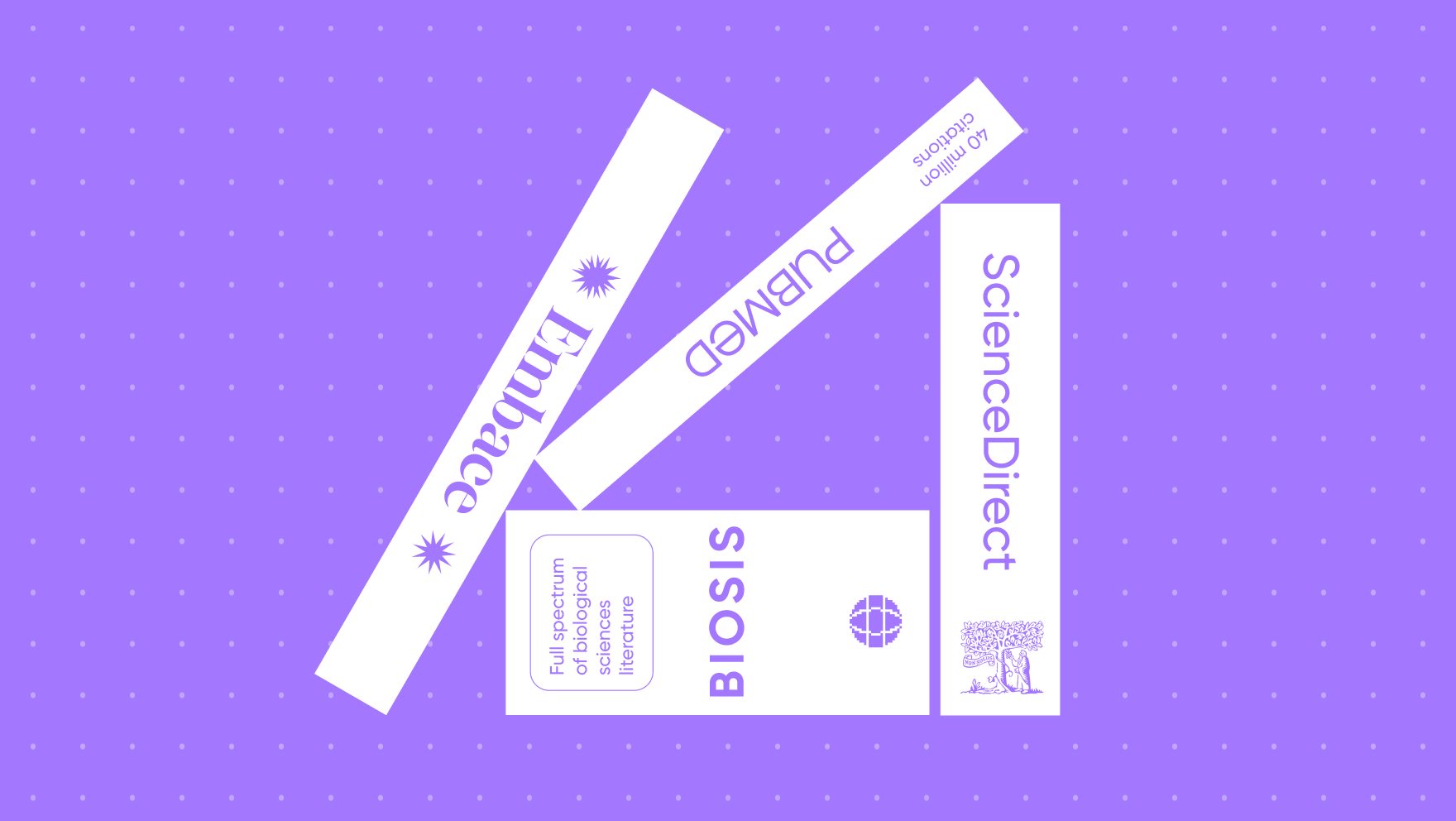
Users formulate a question in natural language. The system then performs a parallel search across several specialized public and non-public scientific sources, including:
- PubMed;
- Embase;
- BIOSIS;
- ScienceDirect.
The identified publications are consolidated and analyzed, and the user receives a structured response based on the retrieved scientific materials.
The platform also provides access to the sources used to generate the response so that the specialists can review the original publications, verify the findings, and examine the underlying information in more detail.
This approach replaces several separate search and review activities with a single automated workflow and reduces the amount of manual work required for the initial literature analysis.
The platform is deployed in AWS, with access restricted within the corporate network to protect user queries and data from non-public sources.
Source-grounded RAG assistant for each research request
Once the scientific literature search is complete, the system automatically prepares the retrieved documents for further work with a dedicated RAG assistant.
At the initial stage, the platform primarily processes publication abstracts. Document preparation takes place in the background, so users do not need to perform additional technical steps.
When the materials are ready, the user receives a notification and can begin working with the assistant.
The RAG assistant allows specialists to:
- ask follow-up questions;
- clarify individual findings;
- compare studies;
- identify contradictions between publications;
- explore the selected materials from different perspectives;
- receive answers based on the publications retrieved for the specific request.
Unlike a general-purpose AI chatbot, the RAG assistant does not rely solely on the language model’s general knowledge, and grounds its answers in a defined set of scientific documents associated with the user’s research question. This makes the analysis more transparent and allows specialists to return to the supporting publications when they need to verify a conclusion.
Deep Search for full-text scientific analysis
For research that requires more detailed evidence, the platform includes a Deep Search mode. It allows users to move from publication abstracts to the full texts of available scientific articles, books, and studies.
Users can choose which materials should be prepared for AI analysis:
- all documents found during the search;
- selected individual publications;
- the most relevant sources for a particular topic.
The available full texts are loaded from scientific systems, processed, and added to the RAG assistant’s knowledge base.
Users can then analyze information that may not be available in an abstract, including:
- research methodology;
- detailed data and results;
- study limitations;
- authors’ findings and conclusions.
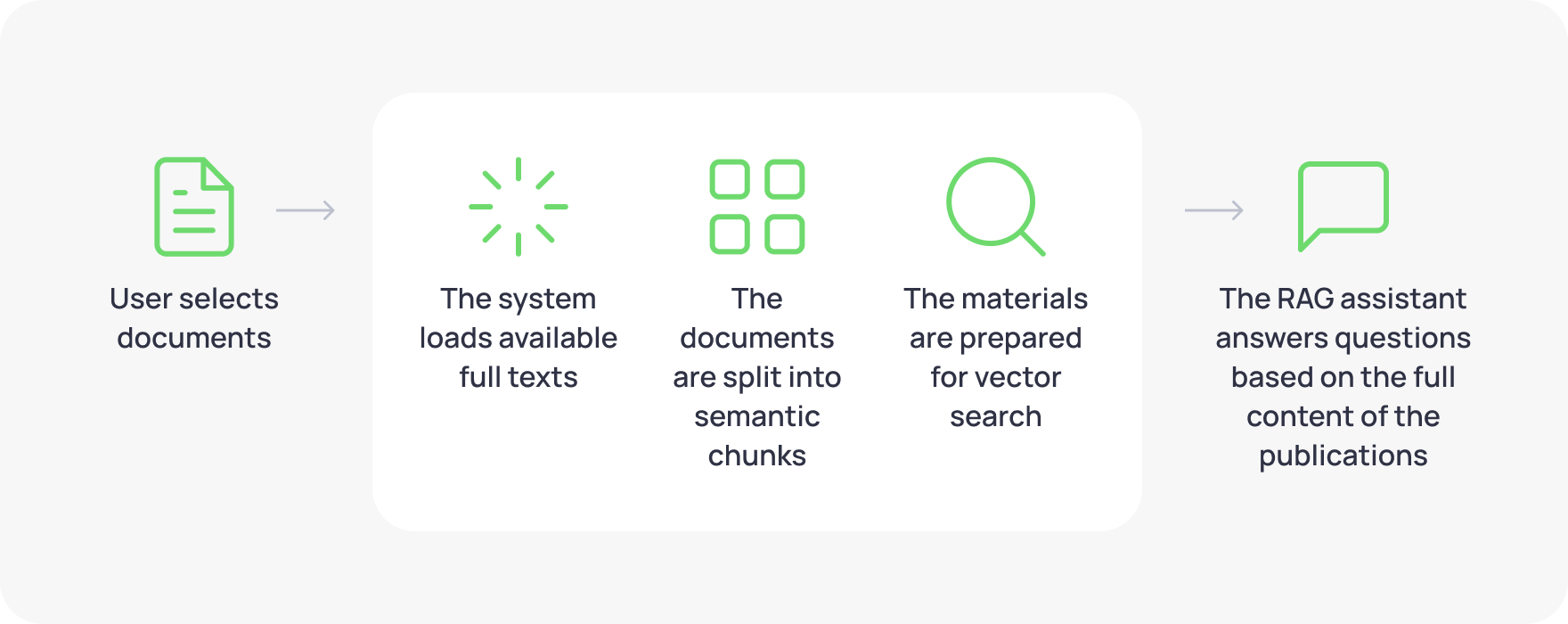
This creates a gradual research process. Specialists can begin with abstracts to assess the available literature and then prepare selected full-text documents when deeper analysis is required.
Business outcome: faster and more transparent literature analysis
Less manual work during the initial review
Searching several scientific databases, opening individual publications, and comparing the findings can take hours or days.
The platform automates a significant part of this process and provides specialists with a consolidated and structured collection of relevant materials. This shortens the path from an initial research question to a usable overview of the available scientific information.
Source-backed answers
The platform generates answers from the scientific materials identified during the search rather than relying only on the general knowledge of an AI model.
Users can review the publications behind the answer and return to the original material to verify specific findings. This supports a more transparent and evidence-based approach to scientific literature analysis.
Support for pharmaceutical research and medical teams
The solution can support several areas within a pharmaceutical company, including:
- medical and scientific research;
- pharmacovigilance;
- drug safety analysis;
- scientific literature reviews;
- evaluation of new therapeutic areas;
- competitive analysis;
- support for medical and regulatory teams;
- preparation of materials for internal experts.
Reusable research knowledge
Once the documents have been found and prepared, they form a topic-specific knowledge base.
Users do not need to repeat the original search every time a related question arises — they can continue the dialogue with the RAG assistant, request clarification, ask additional questions, and examine the same materials from different perspectives.
Support for different research scales
The system can work with a small number of selected publications or larger collections of scientific literature. This makes the approach suitable for both focused expert questions and broader research initiatives.
More than a search engine or AI chatbot
The project created an intelligent research environment that combines:
- natural-language scientific search;
- parallel retrieval from multiple specialized sources;
- automated document preparation;
- structured responses based on retrieved materials;
- access to the supporting publications;
- follow-up analysis through a source-grounded RAG assistant;
- full-text Deep Search for selected documents;
- controlled access within the company’s corporate environment.
For a pharmaceutical company, this means less repetitive work during literature reviews, more efficient use of expert time, and a more systematic way to manage a growing volume of scientific information.
The same approach can also support other industries that rely on large volumes of complex technical, legal, regulatory, financial, or research documents. The key prerequisites are access to trusted information sources, reliable document preparation, a clearly defined knowledge base, and the ability to trace important AI-generated answers back to the original materials.