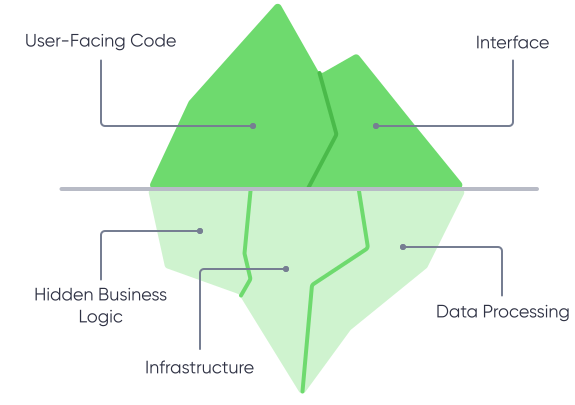
Legacy systems power critical business operations, yet they're often brittle, expensive to maintain, and resist change. The real challenge isn't just old technology—it's the hidden complexity beneath the surface.
Business-critical systems with undocumented workflows
Hidden rules and implicit logic increase migration risk
Manual rewrites are slow, error-prone, and hard to govern
Integrations and data models often poorly documented
Core Modernization Challenge
Structured Process
Modernization requires a repeatable, efficient methodology for seamless transitions.
AI-Powered Acceleration
Leverage LLMs and automation to accelerate understanding and delivery.
Logic Preservation & QA
Preserve critical business logic while adopting modern technologies. Ensure accuracy and operability in target architecture.
Legacy Risk Check: Get your score in 2 minutes
How risky is your legacy system?
Take the free Legacy Risk Check: 11 questions, two scores for risk and migration effort. Instant result, no email required.
Move from manual writing to controllable, AI-powered code generation.
02.
Process Control
Make modernization manageable via instructions, checkpoints, and validation gates.
03.
Maximum Automation
Automate analysis, development, DevOps, testing, and documentation
04.
Repeatable Pipelines
Replace one-off heroics with systematic, repeatable delivery processes.
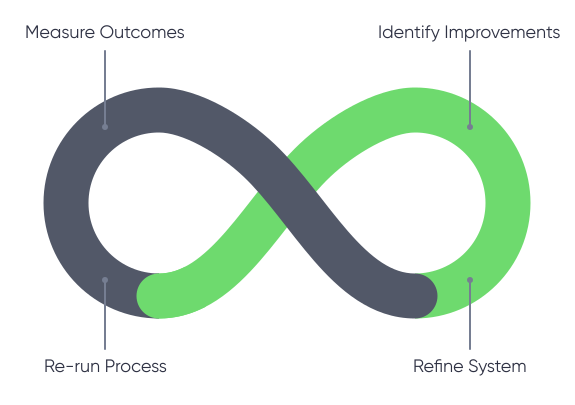
Continuous Improvement at the System Level
The modernization system itself evolves through continuous refinement. By measuring outcomes and iterating on the process, teams achieve progressively better results with each engagement.
Refine instructions and templates based on results
Automate increasingly complex steps
Benchmark LLMs for quality and cost-effectiveness
Apply agentic approaches where appropriate
Leverage Copilot-like developer experiences
Measured Benefits and Realistic Expectations
While outcomes vary by project complexity and legacy system quality, organizations typically see significant improvements across multiple dimensions. It's important to note that AI usage costs can be material, particularly for comprehensive testing and validation workloads.
Develop the modern application using enterprise-grade practices.
Foundation Selection. Choose starter template or build from scratch based on requirements.
Backend Generation. Create services, APIs, and database interactions from metadata and business specs.
UI Development. Generate layouts and data flows using UI kits and standard patterns.
Security & Performance. Embed authentication, authorization, and optimization in the design.
The generation phase leverages the extracted business logic and metadata to produce scalable, modular, and maintainable code that adheres to modern architectural principles.
Go-Live. Application deployed to production environment.
Post-Release Guarantee. Critical issues could be fixed at no charge (unless T&M contract specifies otherwise).
Full Code Handover. Complete codebase transferred; client may modify freely.
Ongoing Maintenance. Support for client modifications requires separate agreement.
Maintenance requests after the guarantee period route through regional directors or appropriate commercial owners for scoping and pricing.
What Success Looks Like Your Path Forward
The modernization journey begins with clear alignment and a pilot that proves the process. From there, scaling becomes a matter of applying repeatable patterns with continuous measurement and refinement.
Confirm Scope
Align on target architecture and business requirements if not predefined
Define Validation
Establish testing strategy, acceptance criteria, and AI cost guardrails
Start with a Pilot
Validate the pipeline end-to-end with a single module or component
Scale to Full Modernization
Apply repeatable governance with measurable outcomes across the portfolio
Left any questions?
Feel free to contact us so we can provide you the details, and your personal quote.
When you submit the completed form, your personal data will be processed by WaveAccess USA. Due to our international presence, your data may be transferred and processed outside the country where you reside or are located. You have the right to withdraw your consent at any time. Please read our Privacy Policy for more information.