






Treasury's new mandate: a conversation with Justin Guerra from Kaufman Hall

Treasury is no longer just a control function — and the organizations that have recognized this are capturing measurably more value. Tanya Kohen, CTP, Global Head of Finance Practice at WaveAccess, spoke with Justin Guerra, Senior Vice President at Kaufman Hall's Treasury and Capital Markets Practice, about what it takes to redesign treasury as a strategic function.

How has treasury fundamentally changed over the last five to ten years?
Consumer behavior set this whole shift in motion. People now expect immediate access to products and services — real-time, frictionless, competitively priced. Banks responded by building mobile applications, digital wallets, and real-time capabilities across reporting, payments, and collections. The corporate treasury had to adapt to the same dynamics.
The most significant transformation has been a reframing of treasury's identity within the organization. Treasury has traditionally existed as a cost center — managing and tracking cash to ensure dollars flow where they need to go. Over the last five to ten years, there has been a seismic shift toward treasury operating as a value generator.
Treasury is uniquely positioned as a bridge between Finance and critical operational groups: Accounts Receivable, Accounts Payable, Payroll, IT, and others. It manages banking and technology provider relationships that elevate the entire enterprise. The organizations that have treated technology as an enabler — integrating right-time visibility, automation, and improved financial decision-making into daily operations through ERP, TMS, and AI tools — have captured the most value. Technology is no longer optional for organizations of any size. The mandate for treasury and technology to speak the same language has never been clearer.
When does treasury's expanding scope stop being "more responsibilities" and start becoming a different operating model entirely?
This tension is something we see with clients every day. Treasury teams are historically thinly staffed, yet they continue to absorb an expanding list of responsibilities: cash and liquidity management, banking and payments, working capital optimization, investment management, debt and capital management, risk governance, forecasting, compliance, and now treasury technology infrastructure management.
The problem is that most organizations pile on responsibilities without doing three things: defining clear ownership of each task, documenting it in written policy and procedure, and evaluating how valuable the task actually is relative to how manual or automated it is.
That last piece deserves unpacking. When assessing the value of any treasury task, the right question is: does this generate financial value for the organization, does it mitigate risk, or does it provide essential data to stakeholders? If a task fails to meet at least one of those criteria, it's worth asking whether it belongs on the list at all.
Then there's the operational lens: how long does this task take, how frequently is the team completing it, and how could technology reduce or eliminate the manual burden?
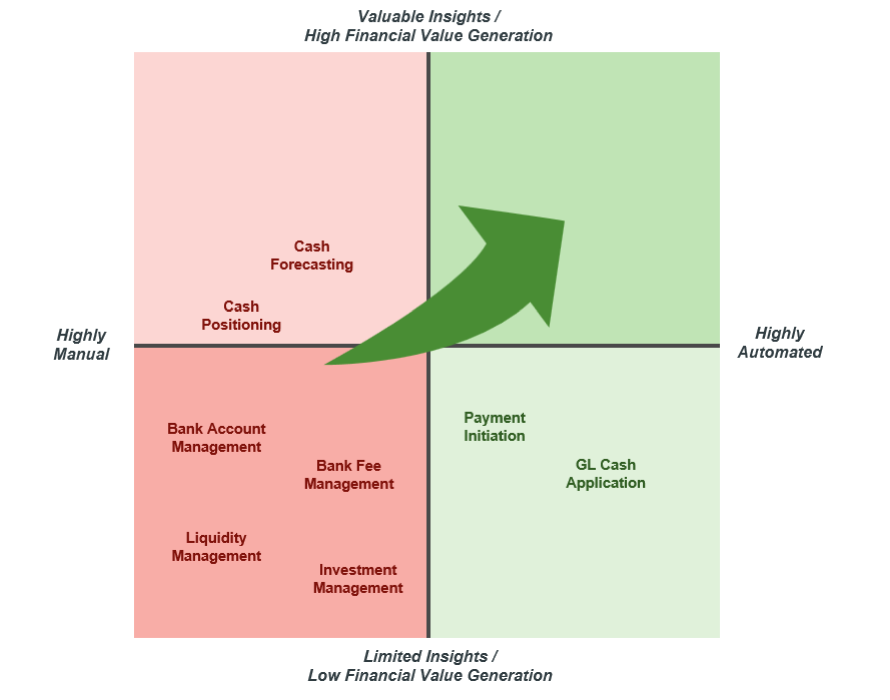
This framework is genuinely useful for defining what treasury's role should be — and for determining where technology should be deployed within a treasury platform. Without it, organizations end up with teams doing more and more without ever stepping back to ask whether they're doing the right things.
Where is treasury creating the most impact when it comes to connecting working capital decisions with liquidity strategy?
Treasury is the steward of enterprise-wide cash — directing it in ways that maximize value across the organization. As the owner of banking relationships, systems, technology, and third-party providers, treasury sits at the center of the enterprise's operational engine.
One of the clearest examples is the procure-to-pay lifecycle. At a typical organization, P2P touches three to six distinct teams with different objectives:
- Sourcing focuses on identifying and contracting vendors at attractive cost and quality.
- Contracting handles agreements and compliance, working closely with Legal.
- Purchasing/Procurement manages requisitions and purchase orders to ensure supply meets demand.
- Accounts Payable handles invoice management, vendor onboarding, and payment execution.
- Finance and Treasury reconciles and reports cash flows, closes to the general ledger, and fulfills audit requirements.
Optimizing that entire lifecycle requires a function that can see across all of it — and treasury, with its central position and strong banking and provider relationships, is well positioned to lead. Organizations that have recognized this have been able to monetize the P2P function to a degree that purely operational teams cannot.
How should treasury leaders think about technology today — as tools they adopt, or as infrastructure they help shape?
The sophistication of treasury technology has grown dramatically over the last decade. Banking portals have advanced significantly; TMS-lite solutions have emerged to address specific, bespoke challenges like cash forecasting; and full-scale TMS platforms have become considerably more capable. Three themes stand out.
First, real-time data integrations are now standard. API-based exchange of transactional and balance-level information is broadly available. Real-time payment execution — for payroll on demand, refunds, reimbursements, disbursements — is increasingly expected. That said, "real time" shouldn't be the default goal. For many core treasury tasks, "right time" is the more appropriate standard. The distinction matters when evaluating infrastructure investments.
Second, data without insights is just data. Collecting, sanitizing, normalizing, and summarizing data — tasks that once consumed hours — can now be completed in seconds with the right technology. More importantly, deriving insights, identifying trends, and surfacing actionable analytics have become automatable through bolt-on tools or native capabilities within ERP, AP, AR, and TMS systems. If your systems don't include these features today, the opportunity cost of not acting is significant.
Third, data fragmentation remains the central problem. Most finance and treasury organizations are sitting on data dispersed across ERP systems, AP and AR tools, TMS platforms, industry-specific software, spreadsheets, and email. The mandate is to identify technology solutions, supported by strong treasury procedures, that centralize and automate data across organizational layers. The ERP and TMS should serve as primary and secondary sources of truth, but that doesn't eliminate the need to explore additional tools that strengthen the overall ecosystem.
If a treasury leader were designing the function from scratch today, what would they do differently?
The structure of the team comes first — because it forms the foundation for everything else. Clearly defined roles and responsibilities, documented tactical and strategic objectives, and an honest accounting of how treasury interfaces with cross-functional partners. That human capital conversation inevitably bleeds into questions of technical architecture, but it has to start with the people.
From there, the technology conversation becomes much more tractable. Once you've outlined treasury's structure and defined its core responsibilities and partnerships, you can evaluate the appropriate technology infrastructure with real clarity. You can run a disciplined diligence process, select the right solutions, implement them, and iterate.
The underlying principle is this: people, processes, and technology are the three levers that amplify the value of a treasury organization. If any one of those three is broken, the symptoms will show up downstream — inefficiencies, misaligned objectives, elevated costs, manual operations, and growing risk. None of the three can be treated as secondary.
How do you think about the difference between invention and innovation in treasury — and why does it matter for practitioners?
The distinction matters practically. Invention is generating a net-new idea, product, or service — The Clearing House developing the Real Time Payments rail is a good example.
Innovation is finding a new application for something that already exists: being the first to deploy that RTP rail within a B2C disbursements use case to differentiate your business.
Both mindsets are relevant for treasury professionals today. Virtual accounts are a useful example. They've traditionally been used to rationalize bank account structures or improve B2B reconciliation. We've taken that same banking tool and applied it in healthcare — where a provider organization historically managed dozens of accounts across hospital locations to accept insurance payments from payers. By pairing a single physical account with underlying virtual accounts and integrating ERP automation, we were able to automate reconciliation and cash posting across the full payer population, simplifying the structure and reducing cost without sacrificing reporting quality. That's innovation: an existing tool, a new context, a meaningfully better outcome.
What are the most significant gaps in today's technology stack for finance and treasury?
Two things stand out.
First, tools that genuinely collapse disparate data sources. ERPs and TMSs are advancing, but there are always data points — sometimes qualitative ones — that fall outside the dataset. Decisions made on incomplete data carry risk that often goes unacknowledged.
Second, insights that sit on top of the data. Humans have traditionally been the engine for deriving insight beyond raw numbers — but teams are being asked to do more with less, and human capacity has limits. The integration of AI, large language models, agentic tools, and RPAs into the tech stack is becoming essential. These tools enable organizations to do exponentially more; the challenge is understanding how to integrate them effectively rather than just layering them on.
Beyond technology, what's the single most impactful improvement most organizations could make?
Leadership — without hesitation.
Strong leadership cultivates culture, character, and vision. It forms the DNA of a team and drives better outcomes across every dimension. The strongest leaders I've worked for have been servant leaders: no task is too big or too small. That posture gets harder to maintain under pressure to scale, but it cannot be compromised.
The qualities that define strong leadership — humility, accountability, integrity, confidence without ego, emotional intelligence, adaptability, and genuine service orientation — are improvable in most organizations, and improving them is among the highest-leverage investments any organization can make.


